
The Start of Chemotherapy
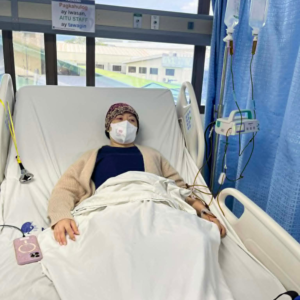
When my chemotherapy finally began, I did not know what to expect. Most of the time, people picture patients sitting in a chair for hours while the medicine runs. Mine was carboplatin and paclitaxel, and they said it would take five to six hours. I have mild scoliosis in my lower back, so the thought of sitting that long already worried me. Thankfully, a bed was available, so I was able to lie down instead.
They placed a Heplock, did the flushing, and gave me the pre-medications. That was when we realized we had not been given clear instructions beforehand. No one told us that I needed to take a steroid the night before and again in the morning—five tablets. No one mentioned that laboratory results had to be ready at least three days before the session. So we rushed to the satellite laboratory, waited for the results, and only then could everything start. It delayed us a bit.
I was nervous when the infusion began. During my hospital stay after surgery, the paracetamol they gave through the IV had stung. I imagined this would be the same, only longer. It was not. It did not sting. For most of the session I simply slept, trying not to feel anything.
There were also rules inside the chemotherapy area. Patients were not supposed to bring food with strong smells because the scent could trigger nausea in others. I kept thinking I might suddenly throw up, even though I felt okay at first.
During the paclitaxel, something changed. My back started to ache and feel tired. Then a strange sensation rose from my stomach toward my chest. It became harder to breathe. I felt like I was gasping for air, as if something was closing in. For a moment I thought I might not make it. I did not know there was a call button beside the bed, so I just waited, hoping a nurse would pass by. None did. I opened Spotify and played worship songs—songs of healing, Don Moen. I lay there listening and praying. Slowly, the tightness eased. The feeling subsided. I thanked God that it passed, but I also realized I should have called for help right away. They have ways to manage reactions like that.
Before we started, they had explained the possible side effects: numbness in the hands and feet from neuropathy, vomiting, a metallic taste when eating, loss of appetite, mouth sores, and hair loss that usually begins after about two weeks. I was afraid of all of it.
The hair loss came. When I combed or washed my hair, large amounts came out. That was how I began to go bald. People tried to comfort me by saying it would grow back, and maybe even better than before. Still, looking at myself without hair was hard. I already felt self-conscious; seeing my reflection made it worse.
Not every side effect happened to me. I did not vomit. I still had an appetite. I never developed mouth sores. What I did experience was the baldness, the numbness in my hands and feet, rashes, and hands that became easily irritated especially after washing dishes. I had to switch to very mild, almost baby-like soap.
The sessions continued. After my third cycle, they ordered a CT scan. It showed wall thickening in the bladder, so a cystoscopy was recommended. There was also a small nodule in the lungs. They could not rule out metastasis, but they also could not rule out simple irritation or inflammation. Because I already had cancer, it was marked for observation and monitoring. There was a lymph node in my left armpit, and bilateral breast masses. Mammogram and breast ultrasound were recommended.
After the sixth cycle, another CT scan would be needed to decide what the next treatment plan should be whether chemotherapy would continue or something else would be required.
We have not been able to do the mammogram and breast ultrasound yet. Part of me wanted to wait until all the cycles were finished so we could compare the findings with the earlier CT scan and see if anything had changed. I was also hopeful that whatever was found in the breasts might still be treated. The bigger reason, though, was money. Even a CT scan of the chest and abdomen costs around ₱30,000, and it has to be repeated every three months. For now, those tests remain on hold.