
The Biopsy Result and the Start of Chemotherapy
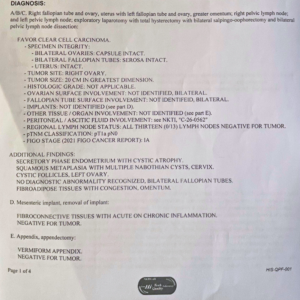
The biopsy result finally came out. It was cancer. Clear cell carcinoma, FIGO stage 1A.
Clear cell carcinoma is an aggressive type of ovarian cancer. Even though it was caught early at stage 1A, and the capsule of the ovary was still intact when it was removed meaning the cancer had stayed contained inside the ovary—the aggressive nature of the disease still mattered. Looking back, that explains how fast it grew. In the early part of 2025, my abdomen was not yet that large. I only really noticed the change during the third quarter of the year. In roughly one year, it had grown significantly. That is what an aggressive cancer can do.
Even after the surgery, there was still a risk that microscopic cancer cells had been left behind—cells too small to be seen during the operation. Because of that, chemotherapy was required. The plan was six cycles, given every 21 days.
My doctor was considerate when she explained the options. She understood that cost was a real concern for us. She did not simply prescribe one path. Instead, she gave us three choices: we could be referred to Jose Reyes Memorial Hospital, we could try the outpatient department of NKTI, or we could proceed with chemotherapy at the oncology department of NKTI itself.
We considered the outpatient option at NKTI first. My mom went to inquire. The process was long, the lines were long, and the area was hot and crowded. It was exhausting for the patients waiting there. Getting a schedule was not straightforward either. You still needed to speak with a doctor, and nothing moved quickly. We wanted to start treatment as soon as possible. Delaying it felt risky.
Jose Reyes was another option we looked at, mainly because we had almost no money. I had already lost my job. I could not work full-time while going through treatment, and night shifts were no longer possible. Freelance work was not bringing in enough. Both of my parents are seniors with no regular income. My father’s pension is not enough to cover their maintenance medicines, the electricity, the internet, and food. Before I got sick, I was the one paying for the internet and electricity, and I also gave a share for food and some allowance. Losing my income placed a heavier burden on them. Chemotherapy sessions can cost around ₱50,000 each, and for some patients the amount goes past ₱100,000 depending on the medicines used. With sessions every 21 days, we did not know where the money would come from.
A neighbor who had gone through chemotherapy at Jose Reyes before discouraged us. They had waited in very long lines and were given a schedule six months later. For a cancer patient, that kind of delay is dangerous. Time works against you. In those six months, the cancer can continue to grow and spread, and by the time treatment finally starts, the body may no longer be strong enough to handle it. We did not want to take that risk.
In the end, we decided to stay at NKTI’s oncology department. All of my records were already there, and transferring would only make things more complicated. We would continue applying for guarantee letters. Some of the ones we received for the surgery still had remaining amounts and reapply every three months as needed. We were scheduled under the doctor who was recommended to me, and a date was set.
That was the beginning of my chemotherapy.